Call Now at 941-235-8242 for Dignified Burial, Cremation, and Memorial Services in Charlotte, Manatee, & Collier Counties


What to Do When Someone Dies in Florida? Step-by-Step Guide Checklist
When someone dies in Florida, the first step depends on the circumstances of death. Call 911 for an unexpected death or medical emergency. Contact the hospice nurse for an expected hospice death. Next, arrange medical certification, contact a funeral home, and obtain death certificates.
Florida law requires death registration within five days. A funeral director coordinates registration and final disposition. Families then address funeral arrangements, government notifications, and estate responsibilities.
What Should You Do Immediately After Someone Dies?
Follow these 7 steps immediately after someone dies:
Contact medical services
Confirm the death
Contact a funeral home
Notify family members & friends
Gather important documents
Choose funeral arrangements
Obtain death certificate
1. Contact medical services
The first thing to do after someone dies is contact the appropriate medical or emergency service. Call 911 if the death is unexpected or the person is unresponsive. Emergency personnel assess the situation and explain the next steps. For an expected death under hospice care, contact the hospice nurse. The hospice team confirms the death and guides the family through the next steps.
2. Confirm the death
Once the medical or emergency team arrives at the death scene, a qualified medical professional confirms death according to the circumstances. Florida requires medical certification of the cause of death. The medical examiner investigates deaths that meet Florida's reporting requirements. These include certain unexpected, suspicious, violent, or unattended deaths.
3. Contact a funeral home
A funeral home coordinates the transfer, care, and final disposition of the deceased person. Contact a funeral director after medical personnel authorize the next steps. Families in Port Charlotte may contact Heavenly Funeral Home Chapel for assistance with funeral arrangements. The funeral director explains the required information, available arrangements, and transportation process.
4. Notify family members & friends
Notify immediate family members, friends, and the people responsible for funeral decisions. These include a spouse, adult children, legal representatives, or other authorized relatives. Identify one family contact to share confirmed information. This reduces repeated calls and conflicting instructions.
5. Gather important documents
Gather the deceased person's identification and relevant records before completing funeral arrangements. The main documents and infromation to gather includes:
A driver's license, passport, or other identity record
Legal name, birth date, and Social Security number
Written burial, cremation, or religious preferences
DD Form 214 for applicable veterans' benefits
Will, trust, or relevant authorization records
A funeral director identifies the information required for death registration. Financial documents serve separate estate administration purposes.
6. Choose funeral arrangements
Choose burial or cremation according to the deceased person's instructions and family decisions. Florida funeral providers offer different arrangements and service options.
Funeral arrangements include traditional funerals, memorial services, direct cremation, and burial services. Each option differs in preparation, ceremony, transportation, and final disposition.
Request the funeral home's General Price List before selecting services. Federal Funeral Rule protections allow consumers to choose individual funeral goods and services.
7. Obtain death certificate
Certified death certificates provide legal proof of death for administrative matters. Banks, insurers, and government agencies request certificates for different purposes.
Ask the funeral director how to obtain certified copies. Florida issues certificates with or without cause-of-death information, subject to eligibility rules. Order copies based on the requirements of each organization. Some institutions accept copies without cause-of-death information.
Who Should You Call First When Someone Dies?
When someone dies, call 911, hospice staff, or the facility's medical team, depending on where and how the death occurred. The table below explain whom to call under what circumstances.
| Place or Circumstance | First Contact | Next Action |
|---|---|---|
| Unexpected death at home | 911 | Follow emergency personnel's instructions |
| Expected hospice death | Hospice nurse | Follow the established care plan |
| Death in a hospital | Hospital staff | Discuss release and funeral arrangements |
| Death in a nursing facility | Facility care team | Confirm medical and transfer procedures |
| Suspicious or violent death | 911 | Preserve the scene for investigators |
What to Do When Someone Dies At Home?
Contact emergency services when someone dies unexpectedly at home. Do not move the body or disturb the scene during a suspected reportable death. Follow instructions from emergency personnel or investigators.
A home death does not always require a police investigation. The circumstances determine whether medical examiner involvement is required.
What Should You Do When Someone Dies in Hospice Care?
Contact the hospice nurse when a patient dies under hospice supervision. The hospice team follows the established end-of-life care plan.
Hospice staff explain medical confirmation, medication handling, and funeral home coordination. The family then contacts the chosen funeral provider.
Hospice care differs from emergency medical treatment. An expected hospice death follows the care plan unless an emergency or unusual circumstance requires another response.
What Should You Do When Someone Dies in Hospital?
When someones dies at a hospital, the staff coordinates medical confirmation and the hospital's release procedures. The family identifies a funeral home for the next stage.
Ask the hospital staff about personal belongings, required paperwork, and release authorization. The funeral director coordinates transportation after the necessary approvals.
The hospital's medical responsibilities differ from the funeral home's duties. Medical personnel address death certification, while the funeral provider handles arrangements and disposition.
How is a Death Registered in Florida?
To register the death in Florida, the State of Florida requires death certificates to be filed within five days after death, under Florida Statutes §382.008. The funeral director or other legally responsible person gathers registration information. The authorized medical certifier supplies the medical certification.
The death registration in Flordia involves the following steps:
Collect personal information: Record the deceased person's legal and identifying details.
Complete medical certification: Obtain the cause-of-death certification from the responsible professional.
File the death record: Submit the required information through Florida's vital records system.
How to Obtain a Death Certificate in Florida?
To obtain a death certificate in Florida, request a certified copy from the Florida Department of Health or an authorized county health department. A funeral director may assist with the initial request.
Follow the 5 steps below to get a death certificate in Florida:
Confirm death registration: Ensure the funeral director has submitted the required death record.
Choose the certificate type: Select a copy with or without cause-of-death information.
Gather required information: Provide the deceased person's full name, date of death, and other requested details.
Submit the application: Apply through Florida Vital Statistics or an authorized county health department.
Pay the required fee: Complete payment and receive the certified copy through the selected delivery method.
Families in Port Charlotte may contact the Florida Department of Health in Charlotte County for certificate assistance
How Do You Arrange a Funeral or Cremation After Someone Dies?
To arrange a funeral or cremation in Florida, choose a licensed funeral provider, select burial or cremation, and review the total costs. The funeral director coordinates transportation, required paperwork, and final arrangements.
Follow these steps to arrange a funeral or cremation:
Choose a licensed funeral home: Select a provider that offers the required funeral or cremation services.
Confirm legal authorization: Identify the person authorized to make final disposition decisions under Florida law.
Select burial or cremation: Review the deceased person's wishes and choose between burial or cremation.
Choose the funeral service: Arrange a traditional funeral, memorial service, graveside service, or direct cremation.
Request an itemized price list: Obtain the funeral home's General Price List to know the exact cost of funeral before selecting services.
Compare funeral costs: Review professional fees, transportation, preparation, merchandise, and third-party charges.
Confirm final arrangements: Review the contract, authorize the required services, and coordinate dates and transportation.
What Not to Do After Someone Dies?
After someone dies, avoid moving the body without authorization, making rushed funeral decisions, or handling estate assets without legal authority. These actions may interfere with death investigations, increase funeral costs, or create legal problems.
Avoid these 7 mistakes after someone dies:
Don't move the body without authorization: Follow instructions from medical personnel, emergency responders, or the medical examiner. Moving the body may interfere with an investigation.
Don't delay reporting an unexpected death: Call 911 when someone dies unexpectedly at home. Contact the hospice nurse for an expected death under hospice care.
Don't rush funeral arrangements: Review burial and cremation options before signing a contract. Request the funeral home's General Price List to compare costs.
Don't ignore the deceased person's wishes: Check written funeral instructions and identify the person legally authorized to make disposition decisions.
Don't use the deceased person's financial accounts without authority: Avoid withdrawing money, using credit cards, or transferring assets without legal authorization.
Don't distribute property before resolving estate obligations: Protect the deceased person's belongings until the authorized representative determines the proper distribution process.
Don't overlook government and financial notifications: Confirm Social Security death reporting and notify insurers, pension providers, and financial institutions when required.
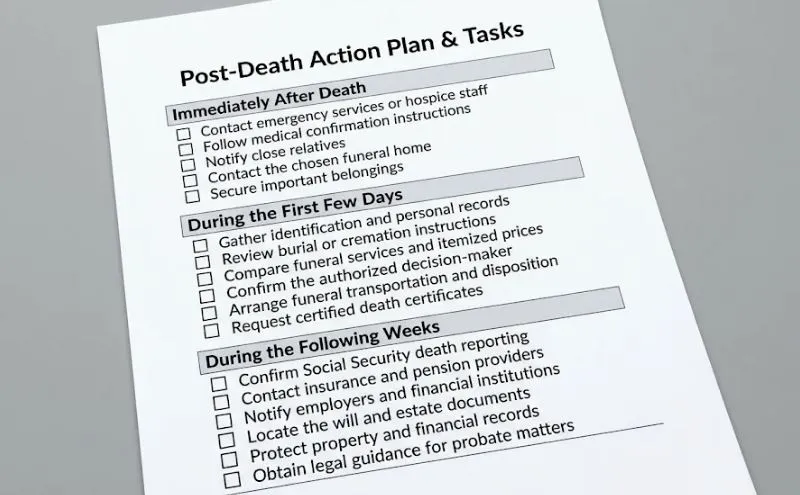
Post-Death Checklist
A post-death checklist separates urgent actions from funeral arrangements and later administrative duties. Download this PDF checklist for later use.
FAQs
How Long Can a Body Remain at Home After Death in Florida?
Under the Florida Statute 497.386, a dead body cannot be held at home or any other private place for more than 24 hours. A dead body within 24 hours must be transferred to a funeral home, crematory, or medical examiner office.
Is Embalming Required After Someone Dies in Florida?
No, embalming is not legally required in Florida for every death. According to the Florida State law, a body must be embalmed only if the deposition does not occur in the first 24 hours of the death.
Who pays for the funeral expenses when someone dies?
Funeral expenses when a person dies are generally paid through the estate or arrangements made by responsible parties. A person who signs a funeral contract may assume payment obligations under that agreement.
Does the funeral home notifies the Social Security after someone dies?
Yes, a funeral home generally report deaths to Social Security. Families should confirm the report and contact the agency about survivor benefits or payment questions.
24/7 Funeral Arrangements in Port Charlotte, FL
Contact Heavenly Funeral Home & Chapel for burial, cremation, memorial, or funeral pre-planning assistance. Our funeral directors help families review their options and coordinate required arrangements.
Copyright 2026. . All Rights Reserved.